If you are thinking about buying your first cows — or you already have a few and want to turn them into a business — the hardest part is usually not the work. It is knowing what to expect. How many months until a calf arrives? How many cows can one person actually milk? What is a tonne of milk worth? And which breed is right for the kind of farm you want to run? This guide walks through the parts of cow farming that stay true no matter where in the United States you are, and it is honest about the parts that depend entirely on your own county, your own buyer and your own vet.
Start with the animal: breeds and body size
There are over 1,000 recognised cattle breeds in the world. The type spread widely across the Americas and other temperate regions is taurine cattle, Bos taurus. Zebu cattle are found mainly in India and the tropics, and sanga cattle mainly in sub-Saharan Africa. So when you shop for cows in the US, you are almost always shopping inside the taurine group.
On the dairy side, the popular breeds are Holstein, Jersey, Guernsey, Ayrshire and Brown Swiss. Two of those come up again and again because they give a lot of milk and adapt well to local conditions:
- Holstein-Friesian — the usual choice for large-scale commercial dairying, the American model most people picture.
- Jersey — the breed most associated with smallholders and smaller herds.
Dairy breeds exist for one purpose: to produce large amounts of milk, which then becomes cheese, butter, yogurt and cream. How much milk each breed gives per lactation, how much butterfat it carries, how much feed it eats and how it copes with heat all vary with the animal, the ration and the farm. Ask a breeder, a nearby dairy or your vet what those breeds are actually doing in your area rather than trusting a number from somewhere else.
Size matters for your handling and fencing
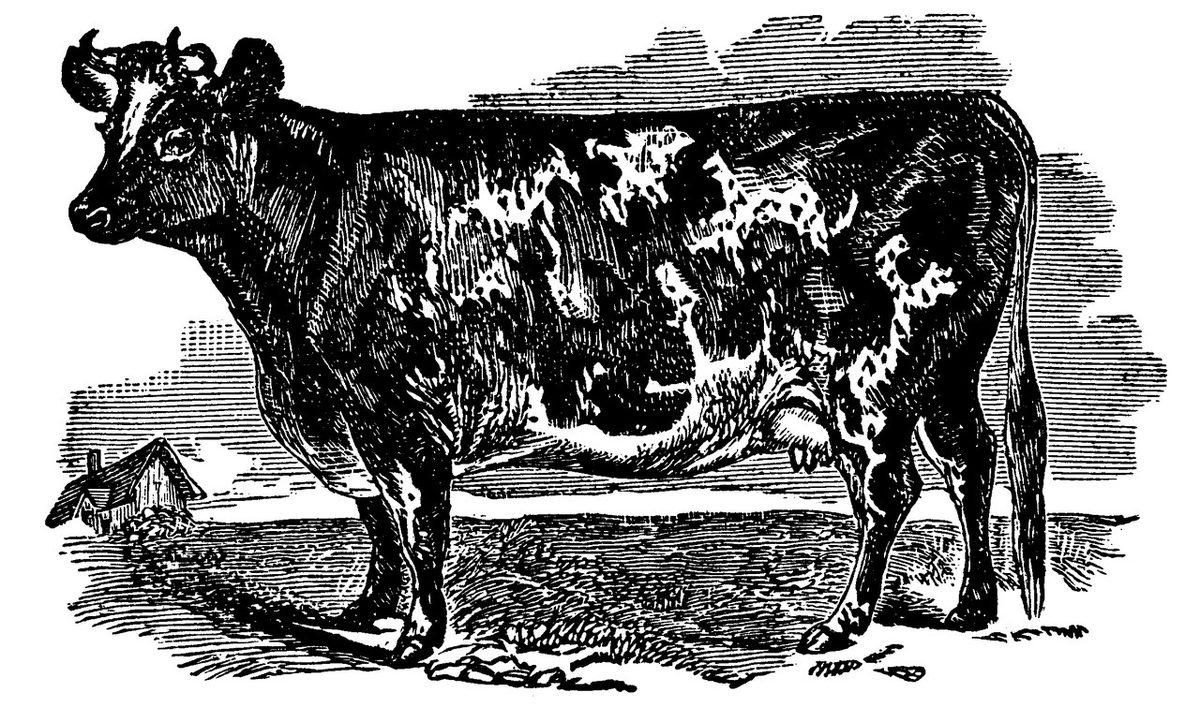
Bulls outweigh cows of the same breed by up to a few hundred kilograms, and breeds differ hugely. British Hereford cows weigh 600–800 kg (1,300–1,800 lb) while Hereford bulls weigh 1,000–1,200 kg (2,200–2,600 lb). At the far end, the Chianina is the tallest and heaviest breed — a mature bull may stand up to 1.8 m (5 ft 11 in) at the shoulder and reach 1,280 kg (2,820 lb). Coat colour also varies by breed: black, white and red or brown are common, with some spotted or mixed patterns.
Cattle have been with us for a very long time, though accounts differ on exactly how long. Some place the domestication of taurine cattle from wild aurochs at about 10,500 years ago, in central Anatolia, the Levant and Western Iran. Others put cattle domestication as early as 12,000 years ago.
How your herd grows: breeding, calving and culling
Your herd size and your income both follow the calving calendar, so this is worth knowing cold.
- Gestation: about nine months.
- Average calving interval: 391 days.
- Sex ratio at birth: roughly 52:48, male to female.
- Calving mortality in the first year of life: 5%.
In semi-wild Highland cattle, heifers first give birth at 2 or 3 years of age, with birth timing lining up with improving natural feed quality. Cows look for a secluded spot to calve, so plan on giving a close-up cow some quiet space rather than crowding her.
Bulls or artificial insemination?
Plenty of farms use artificial insemination — semen deposited artificially in the cow's genital tract — because it lets you pick from a wide range of bulls instead of keeping and feeding your own. Estrus can also be induced artificially, which makes the whole job easier to schedule. Natural service is the other route: copulation itself lasts only several seconds and is a single pelvic thrust.
Calves, weaning and how long cows stay
Left to themselves, calves stay with the mother until weaning at 8 to 11 months. Beef calves suckle an average of 5 times a day, spending some 46 minutes at it, with peaks around 6am, 11:30am and 7pm. That daily rhythm is useful to know if you are checking pairs on pasture.
The natural lifespan of domestic cattle is some 25–30 years, but very few farm animals get near it. In practice, beef cattle go to slaughter at about 18 months of age, and dairy cows leave the herd at about five years. Build your budget around those working lives, not the natural one.
On health — vaccinations, mastitis, lameness, parasites, medicines and withdrawal periods — there is no one-size answer, and the right programme depends on your region, your herd and your regulations. Get a local vet involved before you buy animals, not after.
Feed: you are really feeding a four-part stomach
Cattle are ruminants. They have one large stomach split into four compartments, and it is what lets them turn grass into milk and meat:
- Rumen — the largest, and home to the most important part of the microbiome.
- Reticulum — the smallest, known as the 'honeycomb'.
- Omasum — absorbs water and nutrients.
- Abomasum — works much like a human stomach.
Your cow swallows feed unchewed into the rumen, then brings it back up a mouthful at a time and grinds it with her molars as cud. The actual work of breaking down cellulose is done by tiny partners: bacteria such as Fibrobacter succinogenes, Ruminococcus flavefaciens and Ruminococcus albus, fungi including Neocallimastix species, and ciliate protozoa such as Eudiplodinium maggie and Ostracodinium album.
Here is the practical lesson: if the feed changes over time, the make-up of that microbiome changes in response. A cow's digestion is a living system that adjusts to what you give it, which is why sudden ration swings are risky and gradual changes are kinder. Exact rations, mineral supplements, dry-cow feeding and stocking rates depend on your land, your climate and your forage — work those out with a local adviser rather than copying a ration from another state.
Milking: the ceiling that machines removed
For most of dairy history, milking happened indoors twice a day in a barn, with cattle tied by the neck with ropes or held by stanchions. Feeding could be done at the same time, though most dairy cows were pastured during the day between milkings. You can still see that older way of farming preserved as a historic site at Point Reyes National Seashore. A cow's udder has two pairs of mammary glands, so four teats to handle each time.
Until the late 19th century, all of it was done by hand — and that set a hard limit. One milker could not be expected to milk more than about a dozen cows a day. Some large US operations did exist, running as many as several hundred cows in parts of the northeast and the west, but smaller operations dominated simply because nobody could milk faster.
How the equipment developed
- Bucket milkers — the first machines, in the early 20th century: a bucket sat under the cow and was emptied into a holding tank after each animal.
- The Surge hanging milker — hung under the cow from a wide leather surcingle strap across her lower back, so she could move naturally while being milked.
- The milk pipeline — accounts differ on its timing: some place it among early 20th century large-farm innovations, others describe it as arriving in the late 20th century.
- Rotary parlours — named among the large-scale innovations.
- Automatic milking systems — commercially developed in the early 1990s.
Whatever you install, remember why: your labour, not your cows, is usually the thing that caps herd size.
Cooling and selling: what milk is worth
Milk only became a reliable product once it could be chilled. Refrigeration arrived in the late 19th century — including direct expansion refrigeration and the plate heat exchanger — and cut the spoilage caused by bacterial growth and humidity. Cooling is not an optional extra; it is the difference between a saleable tank and a loss.
Distance matters too. Back in the 1800s the economist Johann Heinrich von Thünen argued there was roughly a 100-mile radius around a city inside which supplying fresh milk was economically viable. Beyond that, milk has to go into durable products such as cheese and butter. Large-scale dairying only works where there is demand for a large volume of milk for those durable products, or a substantial market of people with money to buy milk but no cows of their own. That is why centralised dairy farms grew up around villages and cities where residents had no grazing land.
On price, here is what our own records show for the United States. Across 38 cow milk price observations, drawn from a FAOSTAT feed, the price runs from a low of USD381 per tonne to a high of USD600 per tonne, averaging USD499 per tonne. The most recent observation we hold is dated 2025-01-31. Treat that spread as your planning range, not a promise — what you personally get paid depends on your buyer, and contracts, collection schedules, testing and premiums vary. Ask the dairies and buyers near you directly.
For context, the United States is named among the world's leading dairy industries — as producer, exporter and importer — alongside India, China and New Zealand. Worldwide milk production has generally risen since the late 20th century, reaching around 827,884,000 tonnes in 2017. Commercial dairy farms are usually single-species enterprises, and in developed countries they are normally built on high-producing dairy cows, while goats, sheep, water buffaloes and camels are milked elsewhere.
The criticism and the rules you should expect
Cattle farming carries real environmental scrutiny, and it is better to know that going in. Cattle farming is responsible for about 7% of global greenhouse gas emissions, and there were over 940 million cattle in the world by 2022. Dairy in particular draws concern over manure disposal and air pollution from methane, and over the industry's share of agricultural greenhouse gas emissions. Various measures have been put in place to control the amount of phosphorus excreted by dairy livestock. The use of rBST has been controversial, and animal welfare activists have criticised dairy farming over health problems caused to cows by intensive systems.
How manure handling and nutrient management are permitted and enforced depends on where you farm and how big you get. Check with your local agricultural office before you build, not after.
A low-input idea worth knowing about
If you lean toward grazing with as few bought-in inputs as possible, it is worth reading about natural farming, developed by Masanobu Fukuoka and set out in his 1975 book The One-Straw Revolution. He worked it out against the backdrop of chemical agriculture, which was introduced to Japan by Americans after World War II. It rests on five principles: no tillage, no fertilizer, no pesticides or herbicides, no weeding, no pruning. It is a closed system needing no human-supplied inputs, and it keeps the ground covered with weeds, white clover, alfalfa and herbaceous legumes. Those ground-layer plants are cut from time to time and left on the surface to return nutrients and hold weeds down. Chickens run free in the orchards, and ducks and carp live in the rice fields. After twenty-five years, Fukuoka's farm was reported to yield as much as Japan's most technologically advanced farms, without the pollution, soil loss and energy use.
Be clear-eyed, though: that work was done on rice, barley, vegetables and orchards in Japan. Take the ideas about permanent ground cover and returning cut material to the soil as ideas, and test them small before betting your pasture on them.
Where to go from here
If you take four things away, make them these. Pick your breed for the farm you actually want — Holstein for a large commercial dairy, Jersey if you are running small. Plan your cash flow around a nine-month gestation and a 391-day calving interval, and remember that dairy cows typically leave the herd at about five years while beef cattle finish at about 18 months. Change feed gradually, because you are managing a microbiome, not just a stomach. And solve cooling and your route to market before you milk your first cow — a USD381 to USD600 per tonne range only means something if the milk gets to a buyer cold and on time.
Everything after that is local: your rainfall, your forage, your regulations, your nearest buyer and the herd health picture in your county. Walk a neighbour's dairy, talk to a local vet, and get a price and a collection arrangement in writing before the animals arrive. The biology is the same everywhere. The business is always local.
 Menu
Menu
💬 Comments
Login to comment
No comments yet. Be the first to share your experience!