Horse price in India
Live market rates for Horse in India — 12 real price records from public price sources, plus animals for sale, care tips and a field guide.
Horse price in India today
Kulthi(Horse Gram) (Horse gram (Whole))10 price observations
| Commodity | Market | Price | Date | Source |
|---|---|---|---|---|
| Kulthi(Horse Gram) (Horse gram (Whole)) | Junagadh APMC · India | INR 59 /kg | 22 Aug 2026 | Agmarknet (India) |
| Kulthi(Horse Gram) (Horse gram (Whole)) | Junagadh APMC · India | INR 59 /kg | 21 Aug 2026 | Agmarknet (India) |
| Kulthi(Horse Gram) (FAQ) | Visavadar APMC · India | INR 58 /kg | 21 Aug 2026 | Agmarknet (India) |
| Kulthi(Horse Gram) (Horse gram (Whole)) | Laxmeshwar APMC · India | INR 47 /kg | 21 Aug 2026 | Agmarknet (India) |
| Kulthi(Horse Gram) (FAQ) | Visavadar APMC · India | INR 60 /kg | 12 Aug 2026 | Agmarknet (India) |
| Kulthi(Horse Gram) (Horse gram (Whole)) | Porbandar APMC · India | INR 45 /kg | 12 Aug 2026 | Agmarknet (India) |
| Kulthi(Horse Gram) (Horse gram (Whole)) | Bangarpet APMC · India | INR 45 /kg | 12 Aug 2026 | Agmarknet (India) |
| Kulthi(Horse Gram) (Horse gram (Whole)) | Bengaluru APMC · India | INR 63 /kg | 11 Aug 2026 | Agmarknet (India) |
| Kulthi(Horse Gram) (Horse gram (Whole)) | Junagadh APMC · India | INR 59 /kg | 11 Aug 2026 | Agmarknet (India) |
| Kulthi(Horse Gram) (Horse gram (Whole)) | Porbandar APMC · India | INR 55 /kg | 11 Aug 2026 | Agmarknet (India) |
| Kulthi(Horse Gram) (Horse gram (Whole)) | Gadag APMC · India | INR 46 /kg | 11 Aug 2026 | Agmarknet (India) |
| Kulthi(Horse Gram) (Horse gram (Whole)) | Rona APMC · India | INR 43 /kg | 11 Aug 2026 | Agmarknet (India) |
Where these prices come from
- Agmarknet (India) — Ministry of Agriculture & Farmers Welfare, India (data.gov.in)
About Horse

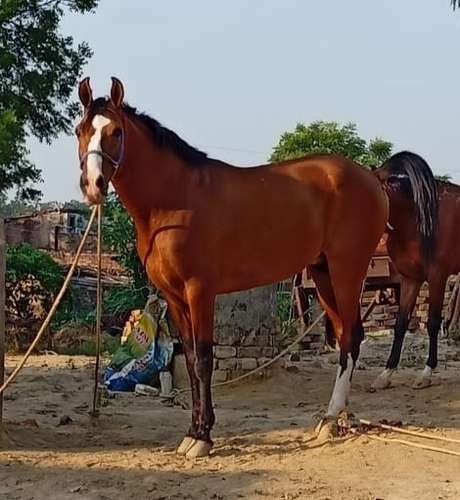
The horse is a domesticated, one-toed, hoofed mammal. It belongs to the taxonomic family Equidae and is one of two extant subspecies of Equus ferus. The horse has evolved over the past 45 to 55 million years from a small multi-toed creature, Eohippus, into the large single-toed animal of today, originally in North America. Humans began domesticating horses around 4000 BCE in Central Asia, primarily associated with the Botai culture; and their domestication is believed to have been widespread by 3000 BCE. Horses in the subspecies caballus are domesticated, although some domesticated populations live in the wild as feral horses. These feral populations are not true wild horses, which are horses that have never been domesticated. There is an extensive, specialized vocabulary used to describe equine-related concepts, covering everything from anatomy to life stages, size, colors, markings, breeds, locomotion, and behavior.
Horse facts & figures
Quick facts
- Scientific name
- Equus caballus
- Diet
- Herbivore (grazer)
- Habitat
- Grassland & farms
- A group is called
- Herd
Conservation status
Source: IUCN Red List via GBIF
Classification
- Kingdom Animalia
- Phylum Chordata
- Class Mammalia
- Order Perissodactyla
- Family Equidae
- Genus Equus
- Species Equus caballus
Source: GBIF
Specs
Typical adult range

 Menu
Menu